Home › Kundli matching
Kundli matching that reads both charts
Guna Milan out of 36, Manglik, Nadi and Bhakoot, and then what a score cannot tell you: how the two of you really are with each other.
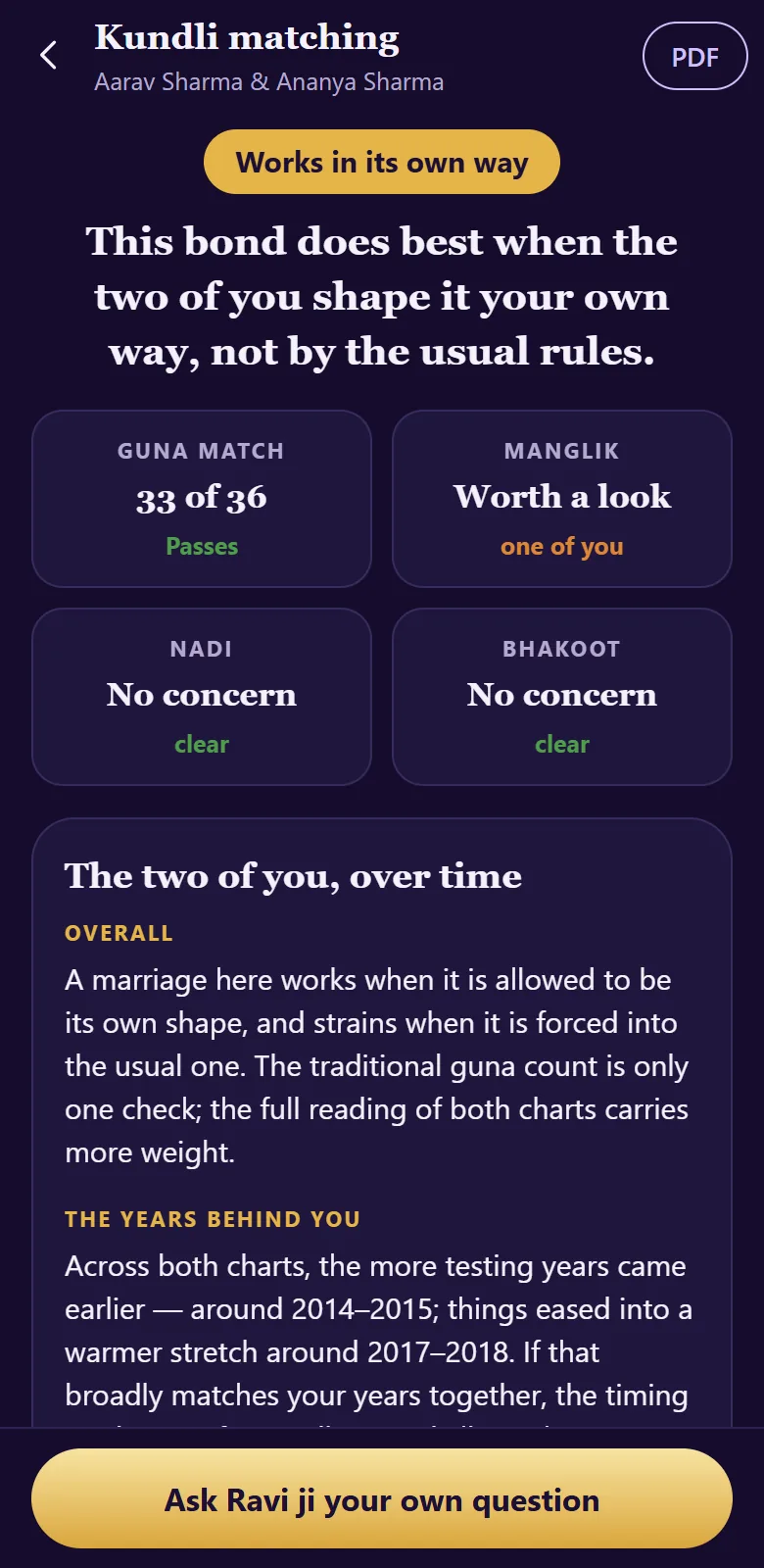
Guna Milan out of 36, Manglik, Nadi and Bhakoot, and then what a score cannot tell you: how the two of you really are with each other.
The score out of 36 and all eight kootas (Varna, Vashya, Tara, Yoni, Graha Maitri, Gana, Bhakoot, Nadi), each in plain words.
Whether each dosha is present, whether it is cancelled, and what it means for the two of you.
Warmth, friction, give and take, and how you handle disagreements, read from both charts side by side.
One shared timeline for the couple: the warmer stretches and the ones that ask for patience.
Ravi ji answers questions about the two of you by name, from both kundlis.
Download the matching as a PDF to keep, print or share with family.
The date and place of birth of both people. A time of birth makes the reading more exact, but a matching can still be read without it, and the report says which parts it leaves out.
A high Guna score does not make a good marriage by itself, and a low one does not rule one out. The traditional count is one check. The report also reads each person's own marriage chart and what passes between the two charts, and says so plainly when the deeper reading and the score disagree.
Use it for a marriage prospect, a fiancé or fiancée, a partner, or your husband or wife. For parents, children and siblings there is a separate family-bond reading.
Traditionally 18 or more is taken as acceptable. The report shows the number and then reads both charts in full, because the count alone can mislead in either direction.
The report says whether the dosha is present in each chart, whether it is cancelled by the other chart or by placement, and what it means in practice.
Yes. The date and place are enough for the Moon-based checks. Parts that need the exact time are marked as not judged.
No. It is calculated from the two birth charts and written by AI in plain words.
No subscription, and nothing renews.